

Bulbs › Lighting Guides › E27 vs B22 vs GU10
Which Bulb Fitting Do You Actually Need?
You've got a dead bulb and the packaging is full of cryptic codes. E27. B22. GU10. This guide cuts through the jargon — plain English, no fuss — so you buy the right bulb first time.
⚡ Quick Answer
E27 = large screw-in fitting, standard in modern UK & European lamps. B22 = push-and-twist bayonet, the traditional British ceiling fitting. GU10 = twist-lock spotlight, used in kitchen and bathroom downlighters. They are not interchangeable. Check the base of your old bulb for the code before you buy.
What Are Bulb Fittings — and Why Do They Matter?
A bulb fitting (also called a lamp cap or base) is the part of the bulb that connects to your light fixture. It determines how the bulb physically locks in and how electricity reaches it.
Buy the wrong fitting and the bulb simply won't fit — no matter how bright or efficient it is. In UK homes, three fittings cover the vast majority of fixtures: E27, B22, and GU10.
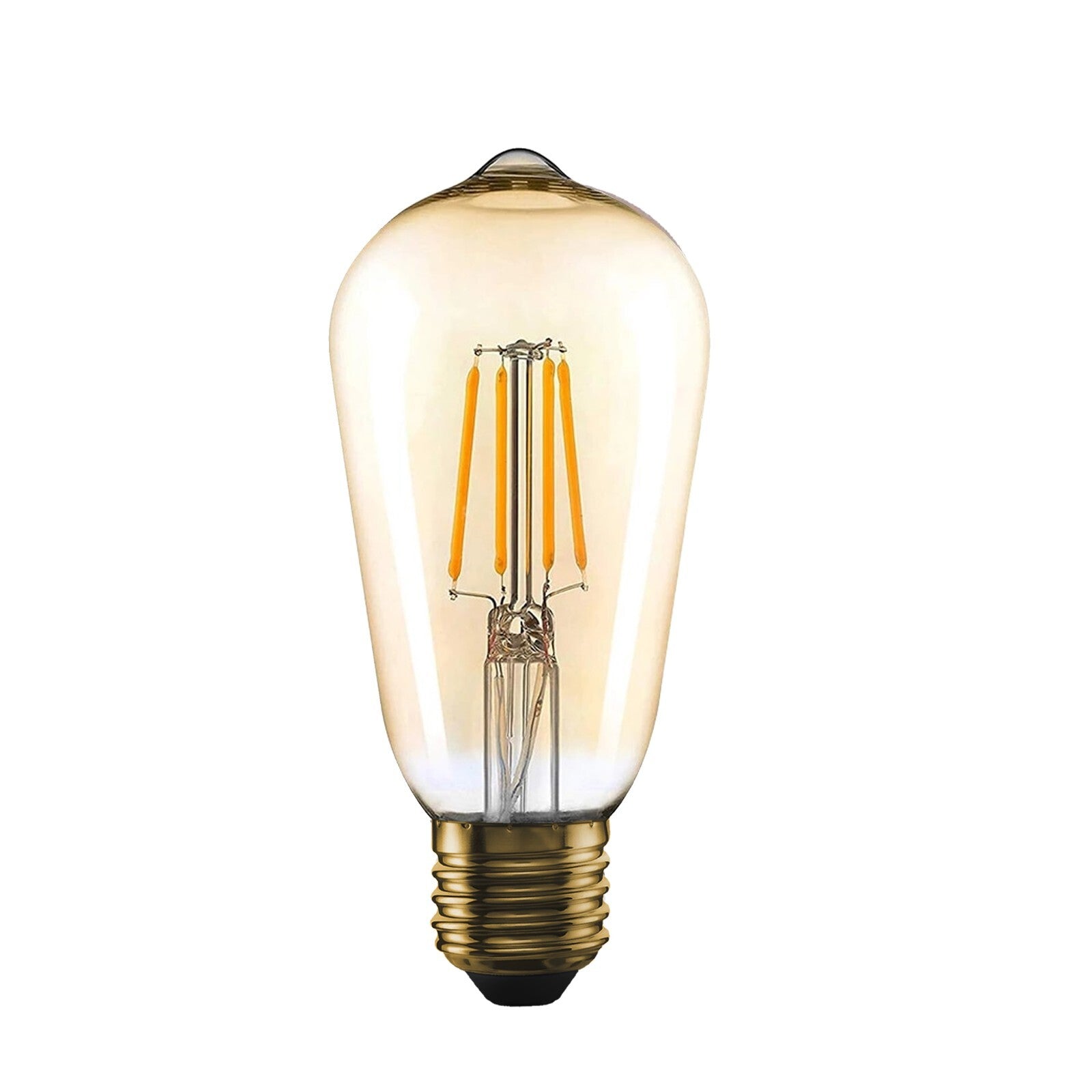
E27
Screw in clockwise. Found in modern pendants, table lamps & floor lights.

B22
Push in, twist right. Classic British ceiling roses & traditional lamps.

GU10
Two protruding pins, push & twist. Kitchen and bathroom spotlights.
E27 The Edison Screw — Europe's Standard
The E27 fitting (E = Edison Screw, 27 = 27 mm diameter) is the most common fitting in Europe, and increasingly popular in UK homes thanks to the growth of Scandinavian-style pendant lighting and designer lamps.
Where you'll find E27 fittings:
- Modern pendant lights and hanging lampshades
- Table lamps with a single large socket
- Floor lamps — especially vintage Edison-style designs
- Outdoor lantern-style wall lights
- Most decorative filament bulbs (Globe, ST64, Squirrel Cage)
E27 bulbs are available in the widest range of styles — energy-saving LEDs, warm filament looks, smart bulbs — making them the most versatile fitting to shop for.
B22 The Bayonet Cap — Britain's Classic
The B22 (B = Bayonet, 22 = 22 mm diameter) is the traditional British standard and still the most widely installed fitting in older UK homes. If you grew up in Britain, you almost certainly grew up with this fitting.
Where you'll find B22 fittings:
- Ceiling lights with a standard rose fitting
- Older table lamps and bedside lights
- Bathroom and hallway pendant lights
- Most homes built before 2005
To fit a B22 bulb: align the two side pins with the slots in the socket, push firmly downward, then twist clockwise a quarter-turn until it clicks. To remove, do the reverse.
GU10 The Spotlight Standard — Kitchens & Bathrooms
The GU10 is a completely different type of fitting. Rather than hanging in a pendant, GU10 bulbs slot into recessed or surface-mounted spotlights. They run at mains voltage (240 V) directly — no transformer required, unlike the older low-voltage MR16.
Where you'll find GU10 fittings:
- Kitchen ceiling spotlights (recessed downlighters)
- Bathroom spotlights (IP65-rated for wet zones)
- Track lighting systems
- Under-cabinet LED spotlights
- Display lighting in retail settings
GU10 bulbs have two thick protruding pins with slightly enlarged tips. Insert with pins aligned, push in, and twist clockwise to lock. They produce a focused, directional beam — ideal for task lighting.
Full Comparison: E27 vs B22 vs GU10
| Feature | E27 | B22 | GU10 |
|---|---|---|---|
| Fitting Action | Screw clockwise | Push & twist right | Push & twist lock |
| Base Size | 27 mm diameter | 22 mm diameter | Two pins, 10 mm apart |
| Voltage | 240 V mains | 240 V mains | 240 V mains |
| Typical Use | Pendants, table lamps | Ceiling roses, lamps | Spotlights, downlighters |
| Common In | Modern & EU-style homes | Traditional UK homes | Kitchens & bathrooms |
| LED Options | ✅ Huge range | ✅ Huge range | ✅ Good range |
| Smart Bulbs | ✅ Wide choice | ✅ Wide choice | ⚠️ Limited but available |
| Beam Angle | Omnidirectional | Omnidirectional | Directional 35–60° |
| Dimmable | ✅ Yes | ✅ Yes | ✅ Yes (check switch) |
| How to Identify | Spiral screw thread | Two side push-pins | Two base locking pins |
Which Fitting Do You Actually Need?
Match your situation to the guide below:
Other Common UK Fittings (Quick Reference)
E27, B22, and GU10 cover the vast majority of UK homes, but you may also encounter:
- E14 (Small Edison Screw / SES) — Smaller screw version used in decorative lamps and chandeliers.
- B15 (Small Bayonet Cap / SBC) — Smaller bayonet used in appliances, night lights, and smaller fittings.
- GU5.3 / MR16 — Low-voltage (12 V) spotlight needing a transformer. Being phased out in favour of GU10.
- G9 — Small loop-pin fitting used in wall lights, bathroom bars, and some table lamps.
- G4 — Tiny two-pin fitting used in cabinet lights, under-shelf LEDs, and marine/caravan lighting.
- T8 / T5 — Fluorescent tube fittings for garages and offices; increasingly replaced by LED tube equivalents.
Frequently Asked Questions
No — E27 and B22 bases are physically different and not interchangeable. Swapping fitting types requires replacing the light fixture itself. Adapters exist but we'd always recommend a proper fixture replacement for safety and reliability.
Absolutely. LED GU10s use around 4–6 W versus 50 W for halogen — over 85% less energy. They also last 15,000–25,000 hours compared to around 2,000 for halogen. With 6 spotlights running daily, the payback period on LED replacements is typically under 6 months.
E26 is the North American standard (26 mm) and E27 is the European/UK standard (27 mm). They are almost identical and E26 bulbs will usually fit E27 sockets — but for UK homes always use E27 to ensure correct fit and electrical compliance.
Two things must be dimmable: the bulb AND the dimmer switch. Many standard GU10 LEDs are not dimmable — look for "dimmable" on the packaging. You'll also need an LED-compatible dimmer switch (not an old incandescent-only dimmer). Check both before buying.
With LED bulbs, always use lumens — not wattage. A quick guide: 40 W incandescent ≈ 470 lm (around 5–6 W LED), 60 W ≈ 806 lm (8–10 W LED), 100 W ≈ 1521 lm (13–15 W LED). All modern LED packaging lists the equivalent wattage clearly.
No — B22 remains a fully active UK standard with a wide range of LED bulbs available. While newer homes often feature E27 fittings, there are no UK government plans to phase out B22 as of October 2026. Millions of UK homes still use it daily.
Find the Right Bulb in Seconds
Browse our full range of E27, B22, GU10 and more — with expert filters for fitting, brightness, colour temperature, and dimmability.
Shop E27 Bulbs Shop B22 Bulbs Shop GU10 BulbsAsk an Expert